As the 25th anniversary of the creation of the San Diego County Regional Airport Authority approaches, we can celebrate the many successes of the agency responsible for the management of our largest airport, but we also call out a missed opportunity that may be ripe for resolving: Bringing all 11 public airports in the county under one operating agency.
The Airport Authority is the government entity responsible for managing San Diego International Airport (SAN) and has successfully carried out the planning and construction of the car rental facilities along Pacific Highway, the new Terminal 2, and the recently completed first phase of Terminal 1. Those projects have all been funded by bonds paid back through revenues generated by the airport without drawing on local tax dollars.
I worked as a chief of staff for the California Legislature and helped craft the 2001 law that created the Airport Authority. At the time, the expectation was that the City of San Diego, which operates Brown Field airport in Otay Mesa and Montgomery-Gibbs airport in Kearny Mesa; the County, which operates McClellan-Palomar airport in Carlsbad, Gillespie Field airport in El Cajon, and five other smaller airports; and the City of Oceanside, which owns Bob Maxwell Field, would eventually roll their facilities into the new agency with the singular focus of improving air travel in our region.
But, that never happened.
Although the new law made the Airport Authority the Airport Land Use Commission for San Diego County, responsible for establishing airport land-use compatibility policies addressing noise, safety, height, density and airspace considerations around public-use and military airports, local governments retain final permitting authority over development in their jurisdictions.
Airports are important regional assets which affect tourism, businesses, and travel, but the public is mostly unaware of the planning and coordination required to make them operate efficiently and effectively.
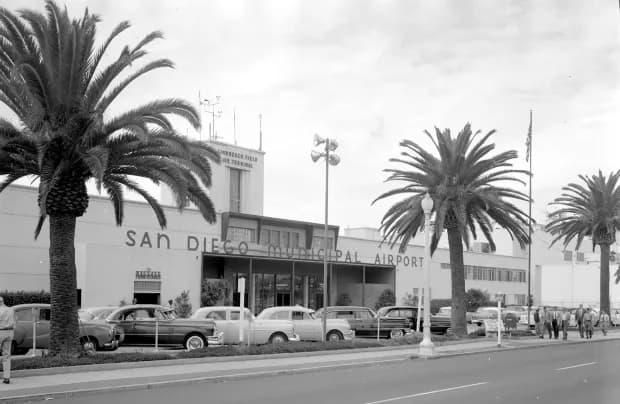
San Diego Municipal Airport was established in 1928 and named Lindbergh Field just one year after Charles Lindbergh’s historic flight across the Atlantic. San Diego’s airport was funded by voter-approved bonds and built on marshland that was part of what was then known as Dutch Flats. The area was already home to the new Marine Corps recruit depot, and Ryan Flying School, whose founder, T. Claude Ryan, later built Lindbergh’s Spirit of St. Louis where Solar Turbines sits today.
The airport operated for 35 years under the control of the City of San Diego, but in 1962, it was moved under the jurisdiction of the newly created San Diego Unified Port District, which has control of all tidelands in San Diego Bay, including the land under the airport.
In 2001, the California Legislature passed a new law establishing the San Diego County Regional Airport Authority, which assumed control of the airport from the Port District in January 2003, creating a standalone agency responsible for operating SAN and planning for the region’s future air transportation needs.

The legislation authorized the new regional agency to accept other public airports if their existing operators transferred them into the Authority—hence the word “Regional” in its name—but it cannot take them on its own.
A combined regional agency could better coordinate the airports as a single system and improve overall air capacity in the region.
Airport revenues are generally restricted by federal law to airport-related purposes. Parking, concessions, ground leases and other airport revenues therefore cannot simply be diverted to unrelated governmental programs.
The City of San Diego, the County and Oceanside have little ability to use airport revenues to support their general funds, so there is no fiscal advantage to maintaining separate airport management structures.
Airports are notoriously hard to open, but sometimes even harder to close down.
This week, San Diego City Council candidate Nicole Crosby, a lawyer within the San Diego’s City Attorney’s office, twice mentioned closing Montgomery-Gibbs airport in Kearny Mesa to make way for housing. It’s not that simple.
Although there are development and neighborhood pressures to close local airports, federal law discourages their closure because the FAA must first approve the decision, and federal funds used to purchase and improve an airport may have to be returned. Additionally, some local airports, including Montgomery-Gibbs and Brown Field, have more restrictions that could prove difficult to overcome if they were closed to aviation uses.
Montgomery-Gibbs, where federal funds were used to buy some of its land, cannot be closed without FAA release, and the share of the land that was purchased with federal dollars may have to be repaid or reinvested at today’s fair market value, not the amount originally granted by the feds.
In 1962, US Naval Auxiliary Air Station Brown Field was deeded to the City under a surplus-property deed and would revert to the federal government if it ceased to be an airport.
After years of debate, San Diego voters turned down the option of moving SAN to Miramar airbase in 2006 when Measure A was defeated by a margin of 62% to 38%. With Miramar no longer part of the region’s immediate airport debate, the Airport Authority proceeded with major investments at SAN to make our airport a more competitive international destination. The Airport Authority deserves credit for its work.
Now it’s time—if not years overdue—to better coordinate our region’s air transportation system by consolidating the operation of our 11 public airports under one unified agency.
Four agencies running airports in our county is three too many.
At a time when both the City of San Diego and the County are running structural deficits and are looking for ways to streamline their internal operations, and the City of Oceanside is running a razor thin surplus on its $744 million budget, transferring their airports to the Airport Authority seems like a smart move that would reduce government inefficiencies and lead to better management of our regional aviation assets.
San Diego was at the leading edge of commercial aviation development 100 years ago and we should continue to be today.
City of San Diego, County, and Oceanside leaders should move their airports into the Airport Authority for the good of the region and the more than 25 million air travelers who use our airports each year.
Arturo Castañares is the Publisher and Editor-at-Large of La Prensa San Diego. Before becoming a journalist in 2015, Castañares worked for more than 25 years in government and politics, including 13 years as staff to the California State Legislature, where he helped craft and negotiate the legislation that led to the creation of the Airport Authority. Castañares is also an FAA-licensed private pilot who has flown extensively throughout the continental US and Alaska.