Photo credit: Victor Alemán

Today would have been César Chávez Day in California, but, after the exposure two weeks ago of sexual abuse perpetrated decades ago by a civil rights icon, his name has been stripped from the state holiday, along with moves to remove his name from schools, parks, roads, and memorial.
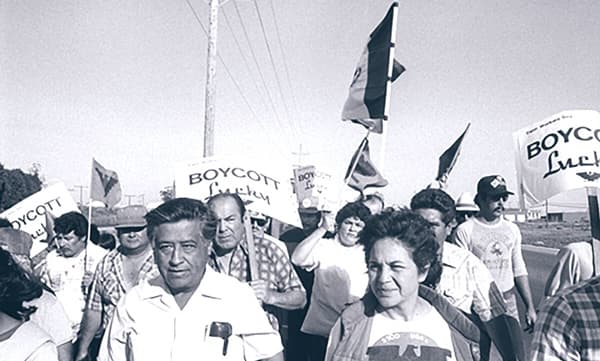
Last week, Governor Gavin Newsom signed a bill passed quickly by the Legislature, to rename today as Farmworkers Day in honor of the people Chávez became famous organizing.
The revelations about Chávez sent shockwaves through political and social circles as the gravity of the stories really hit. It was devastating news that has rocked the Latino community as we struggle to reckon with the truth that one of the most revered civic leaders had a deep dark past that will forever taint his legacy.
We lost an icon, a hero in the Latino community we honored as an example of leadership and sacrifice. As a young Latino who entered politics as a teenager in 1989, I met Chávez in 1991 and attended his funeral in 1993, then later, while working for the Legislature, witnessed first-hand as California became the first state to create a holiday for him in 2000 to be celebrated on his birthday, March 31st.
The breaking news two weeks ago was not a set of allegations; it was a series of confessions from the women who suffered at the hands of the venerated union organizer who helped improve the lives of millions of workers while he was quietly abusing women and children for his own pleasure.
The young girls who were groomed and abused lost their innocence and were understandably tormented by the betrayal of trust by their exalted leader. These were daughters of union organizers who worked with Chávez while he was preying on their vulnerable children. Their stories deserve to be told.
But one of the most troubling parts of the story is the abuse of Dolores Huerta, the union co-founder and iconic civil rights worker who walked hand-in-hand with Chávez while, she now admits, was the victim of two sexual assaults that led to pregnancies and children she secretly placed with other families to raise.

In an interview last week with ABC News' Mike Quiñonez, Huerta admitted the two encounters were non-consensual; rape.
As devastating as the impacts of sexual assault are to victims and their families, Chávez left another lasting impact by fathering two children with the woman who was his partner in fighting for workers’ rights movement that helped uplift workers—and Latinos in general—in the United States.
Huerta admitted the abuse last week, something she held secret for over 60 years, saying she kept the abuse hidden because “exposing the truth would hurt the farmworker movement” she had spent her entire life fighting for.
She’s most likely right. At the time of the abuse, the farmworkers’ fight for fair pay and better working conditions was fragile and struggled to gain the attention and support of mainstream news and the greater public.
The disclosure of her rape and illegitimate children fathered by her boss could have destroyed their work just as it was beginning to make a real difference in our country.
I can understand that dilemma.
But, what is now hard to process is how Huerta and others kept the secret even after Chávez died in 1993 as schools, parks, streets, and memorials were built and named for him, raising his profile to be spoken in similar ways as Bobby Kennedy, Martin Luther King, Jr., and Rosa Parks.
Her silence as a victim is understandable, but her promotion of her abuser is troubling. She knew they were building literal statues of him on a foundation of lies and secrets, yet she ran headstrong into the future with no reservations about what could come. We asked her to carry the weight of a movement, but in doing so, we unwittingly forced her to carry the weight of his crimes.
Huerta must have known that any secret that more than one person knows is not a secret, it’s a ticking time bomb counting down until its eventual explosion. In this case, implosion. She knew it was a house of cards, yet she continued to build it up, knowing the danger the inevitable disclosure would likely bring.
Huerta and others continued to build on the legacy of César Chávez knowing we had placed our faith in a flawed man who had serious skeletons in his closet. Maybe she could have transitioned the movement to be more focused on current leaders and workers than on the flawed character we thought we knew.
Huerta should have become the leader of the movement and the face of the fight to protect it and us from the inevitable crash. As we now know, she would have been a more worthy hero.
Now Huerta is a victim of both abuse and of the cover up, but she didn’t come forward on her own. It was only after intensive investigative news reporting uncovered the truth that she and others came forward.
In a matter of hours after the New York Times broke the story based on several years of their investigation and interviews, Chávez went from folk hero to tainted abuser. Statues of him have already been covered in black cloths, and moves are afoot (even here in San Diego) to strip his name from streets, parks, and, most appropriately, from our schools. Those are all understandable reactions.
This is not like the modern day cancelling of historic figures like Thomas Jefferson for owning slaves and fathering children with Sally Hemings, or removing Confederate Generals’ statues 100 years after they were erected. Those were cases of long-dead people being judged using today’s yardstick without considering the times in which they lived.
No, this is exposing child abuse and sexual assault that was as abhorrent in his time as it is today. There is no excusing, defending, or ignoring these acts.
The Latino community, and American society as a whole, must confront this new reality head on. We have to be honest about the steps that must be taken to expose the truth about what Chávez did, and support the victims, past and present.
We must consider how to deal with the countless honorifics named for him, whether to rename them or destroy them completely.
But we also should not run to blame those who supported workers’ rights, or celebrated Chávez for his public accomplishments when we didn’t know the truth about his private behavior. We are all victims of his betrayal.
And nothing in this debate should take away from the work and accomplishments of the farmworkers themselves who endure back-breaking work so that we can all enjoy the crops they pick with their own hands. That work continues to be done primarily by immigrants who do the work that no one else in this country is willing or able to do. We all own them our gratitude.
The legacy of César Chávez has forever been changed. He cannot be honored like he was just days ago because now we know what we didn’t know before: He was an abuser of children and women. We cannot ignore that.
It is a sad day for the victims who long suffered in silent shame, who held their secrets private even as they caused immeasurable pain. Hopefully, speaking their truths now will help toward healing their pain.
And it’s a sad day for millions who held Chávez up as a role model who fought for the rights of others in heroic ways. We have been robbed of a hero.
We have all lost. We are all affected. And we must all move forward in a positive way together.
And as for the famous slogan, Sí se puede, coined by Huerta during the 25-day hunger strike Chávez held in 1968, we have to reckon with its new symbolism.
Will it continue to be a battle cry for organizers and workers who fight for better conditions regardless of these new revelations, or will it take on a new meaning as the slogan for recovery and renewal after we exorcize the demons of Chávez’s actions?
We are at a crossroads. How we act in this moment says more about us than about him. He is gone, but the impacts of his actions—both good and bad—live on. We cannot simply gloss over this news. We have to process it, and react to it. The world is watching us.
The solution may not be as simple as we think.
But we must also contend with the reality that naming prominent things or places after people runs the risk of later discovering something about them we didn’t know. Sometimes, no one knew.
So we must accept the possibility that such a fall from grace may come and we’ll have to deal with the consequences, or, we should stop naming things after people.
For now, we must accept the fact that a hero has fallen, rightfully so, for his own bad actions have now eclipsed his good ones.
Sí se puede. Adelante. Together we are stronger.
Happy Farmworkers Day!