
The US Supreme Court this week struck down President Trump’s Executive Order ending automatic birthright citizenship, launching a wave of objections from Trump and conservatives who knew this issue is good for them going into what could be a disastrous midterm election for Republicans.
Trump issued his Executive Order on his first day of his second term, setting off what was sure to be a long legal battle that could shape how immigration works in our country going forward. Republicans cheered the order as a way to stop what they claim is unchecked immigration and “anchor babies” who gain citizenship for their entire family by virtue of where they are born. It seems that immigration is one of the go-to hot-button issues used every time Republicans fear losing elections; e.g., 1994’s Proposition 187.
But Trump’s order was almost immediately challenged by lawsuits filed by the ACLU, the NAACP, and multiple states, all claiming the order violated the 14th Amendment, the Supreme Court precedent set in the 1898 Wong Kim Ark case, and the Immigration and Nationality Act passed by Congress.
Federal judges issued injunctions and the case made its way to the Supreme Court, which issued its ruling this week, striking down the order as inconsistent with the 14th Amendment and the Ark case.
The vote was 5-4, with Chief Justice Roberts and Justice Barrett joining the three liberals; Sotomayor, Kagan, and Jackson. Justices Thomas, Kavanaugh, Gorsuch, and Alito dissented.
Although the close vote may seem like the issue is a close call, the more troubling part is that four Justices still voted against the decision.
The Court was right in striking down Trump’s order even before we argue the merits of whether birthright citizenship is right, whether it is good or bad for the country, or even if it is actually covered by the 14th Amendment.
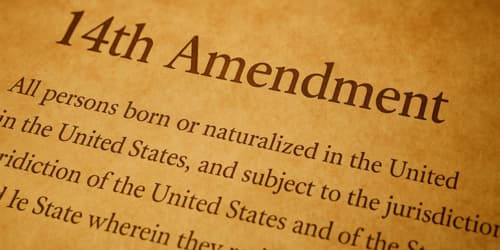
Strictly reading the text of the 14th Amendment, it seems clear that “All persons born or naturalized in the United States, and subject to the jurisdiction thereof, are citizens of the United States and of the state wherein they reside.”
It is undisputed that the Amendment, passed just three years after the end of the Civil War, was focused on the rights of freed slaves, but the language could have referred to slaves, freedmen, former slaves, or other definitive descriptions to limit the language. Furthermore, why would a Constitutional Amendment be necessary to continue to provide the right of citizenship to “all persons born or naturalized” long after the issue of former slaves was decided within the lifetime of those individuals?

Conservatives love to claim to be “strict constructionists” until the plain language written at a sixth-grade reading level no longer suits their arguments. If the 14th was only about former slaves, why doesn’t it just say that?
Another inconvenient truth is that the Supreme Court decision in the Wong Kim Ark case in 1898, thirty years after the passage of the 14th Amendment, dealt with the case of the US-born child of Chinese parents legally living in the US. Ark was denied entry back into the US after a trip to China. Clearly that case was not about slaves or their ancestors; it was about a US citizen born to a non-US citizen mother who was being discriminated against because of the punitive Chinese Exclusion Laws.
Although Ark’s case was the first birthright challenge to make it to the Supreme Court, four similar cases were upheld in lower federal courts in 1884, 1888, and 1892.
This week’s decision was in line—even if unpopular—with case law regarding birthright citizenship. No case has ever won in court where the citizenship of someone born on US soil was challenged.
But regardless of the case law or the arguments for or against birthright citizenship, the way Trump attempted to unilaterally alter such a fundamental right in this country should have been struck down if for no other reason than for its lack of procedure. Every American who cherishes our Constitution should celebrate that, because no President, this one or any other before or after him, should have the power to limit constitutional rights with the stroke of a pen.
Presidential Executive Orders are directives to manage functions of the federal government, not to change laws or amend or even clarify the Constitution. They deal with internal affairs of our government, deciding how and to what degree legislation will be enforced, dealing with emergencies, waging wars, and in general fine-tuning policy choices in the implementation of broad statutes. EOs are also not permanent; they can be, and often are, removed or changed by subsequent presidents. Imagine the outcome if citizenship was granted or denied, back and forth, by subsequent presidents.
Only Congress, not a President, has the power to amend the Constitution, either by repealing or amending it, not by arbitrarily limiting the rights it confers. And, of course, at least 38 states need to ratify an amendment, making it a necessarily difficult process that should not be done by one person.
The 14th Amendment’s plain language in its Section 5 also clearly states that “Congress shall have power to enforce, by appropriate legislation, the provisions of this article”, not a president.
And, remember the Legislative Branch’s power and responsibility to check a runaway legislative or executive branch? That is exactly what the Court did. This is American government on display.
So, without arguing the merits—or lack thereof—of ending birthright citizenship, we should all agree that a president cannot and should not be empowered to attack our constitutional rights.
If Trump and the Republican-controlled Congress wanted to specifically limit birthright citizenship, they would need to pass a Constitutional Amendment, and then both houses of at least 38 state legislatures would have to ratify it. By the way, only 28 states have Republican-controlled legislatures, making it virtually impossible to ratify such an amendment.
Maybe this time you agreed with Trump on this issue, but would you agree that a later president could sign an Executive Order limiting, say, the 1st Amendment’s freedom of religion or speech, or the 2nd Amendment’s right to keep and bear arms? Of course not. That’s not what the Founding Fathers envisioned.
The Supreme Court had become very political, but also unpredictable. This week alone, they ruled against Trump on his appeal to throw out E. Jean Carroll’s $5 million+ sexual assault verdict against him, on his right to remove a member of the Federal Reserve while her legal challenge continues, and in a landmark case that attempted to limit the counting of election ballots received after Election Day—even though Trump appointed a third of the Justices. In fact, one of his three appointees—Amy Coney Barrett—voted against Trump in both the birthright and ballot-counting cases.
Armchair wannabe lawyers will argue these cases until they are blue in the face, but we should all agree that the system our Founding Fathers envisioned still works today. The Constitution, not politics, carried the day.
As we celebrate the United States’ 250th birthday, we should not only cheer the fireworks and barbecues, but remember the special nature of our Constitution and the checks and balances it includes that granted us—and protect—the rights we cherish so much.
Happy Fourth of July! God bless America..