Photo credit: David Paul Morris/Bloomberg via Getty Images
The Department of Justice last week sued California, asking a federal court to prevent the state from counting mail-in ballots cast by roughly 20,000 registered voters the Trump administration identifies as “likely noncitizens.” The lawsuit comes amid a broader federal campaign to investigate alleged noncitizen voting, while California officials question the evidence and methodology behind the government’s claims.
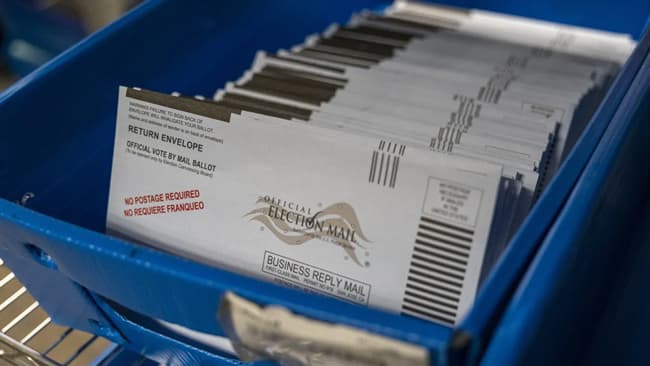
The complaint, filed Oct. 15 in federal court in Los Angeles, seeks an order requiring California to set aside ballots from people on a federal list until their citizenship can be verified. California has already mailed ballots to active registered voters, and voting is underway ahead of the Nov. 3 midterm elections.
Acting Deputy Attorney General R. Trent McCotter sent letters to California Secretary of State Shirley Weber and Los Angeles County Registrar-Recorder Dean Logan, giving officials 48 hours to review a federal list of suspected noncitizen voters and set aside ballots that could not be verified. The list was provided to Los Angeles County on a password-protected thumb drive, but Weber’s office said it was not given the list directly.
California officials objected to the short deadline and the lack of supporting information. Weber called the demand “an emergency of the DOJ’s creation” and said the state would not disenfranchise voters based on information or methodology the federal government had not adequately explained.
This is not the first such assertion from the administration.
In July, Homeland Security Secretary Markwayne Mullin said a preliminary review had identified as many as 190,832 potentially noncitizen registrants in California. State officials requested the underlying methodology and data sources, saying they needed that information to evaluate the claim. The current lawsuit focuses on a list of roughly 20,000 people, but the federal government has not publicly explained why the earlier estimate was so much larger.
Similar claims have faced challenges elsewhere. The Department of Homeland Security initially said Nevada could have as many as 15,903 noncitizens on its voter rolls. After further review, the department said it had identified 185 people it believed were noncitizens. Nevada officials later disputed that finding, saying their records showed all 185 were citizens. The episode illustrates the risk of treating preliminary database matches as conclusive evidence of ineligibility.

The list in the current case originated from a comparison of public voter-registration records with Department of Homeland Security data, processed in part with third-party software and commercial sources. Federal officials say their review involved multiple agencies and verification methods, but California officials have questioned whether the information is sufficient to justify withholding ballots before individual voters’ citizenship can be established.
Brennan Center for Justice election expert Gowri Ramachandran criticized the request, arguing that the executive branch lacks constitutional authority to dictate how states administer elections.
“The Constitution gives no authority to the Executive Branch to determine how elections should be administered, including authority over voter registration list maintenance,” she wrote in a public thread responding to the filing.
Courts have rejected several related efforts by the administration to obtain unredacted voter rolls or compel changes to state voter-registration procedures. Those cases involve distinct legal questions, including access to voter information and the federal government’s authority over state election administration.
Voting-rights advocates warn that flawed matching processes can wrongly flag naturalized citizens whose earlier immigration records have not been updated. The concern is particularly relevant in California, including San Diego County, where naturalized citizens are part of many communities and where election officials must distinguish eligible voters from those legally barred from voting.
Gov. Gavin Newsom called the lawsuit “a sad, desperate attempt” to suppress California voters weeks before Election Day. California Attorney General Rob Bonta’s office has said the state will defend its election procedures.
San Diego County election officials follow statewide rules requiring ballots to be mailed to every active registered voter. Voters may return ballots by mail, drop box, or in person through Election Day. The federal lawsuit now puts the state’s handling of ballots from people on the government’s list at the center of a dispute over how citizenship should be verified without improperly preventing eligible voters from having their ballots counted.